tagrawla
Challenge Description
There’s talk of an uprising. Blades are sharpened, armors fortified. Intercept the hidden message and uncover the secret operation.
Provided Files
Solution
This challenge is based on DNS-based data exfiltration—specifically, how data can be encoded into DNS queries and stealthily transmitted.
Step 1: Open the Capture
Opening the tagrawla.pcapng file in Wireshark immediately shows a large number of DNS packets.
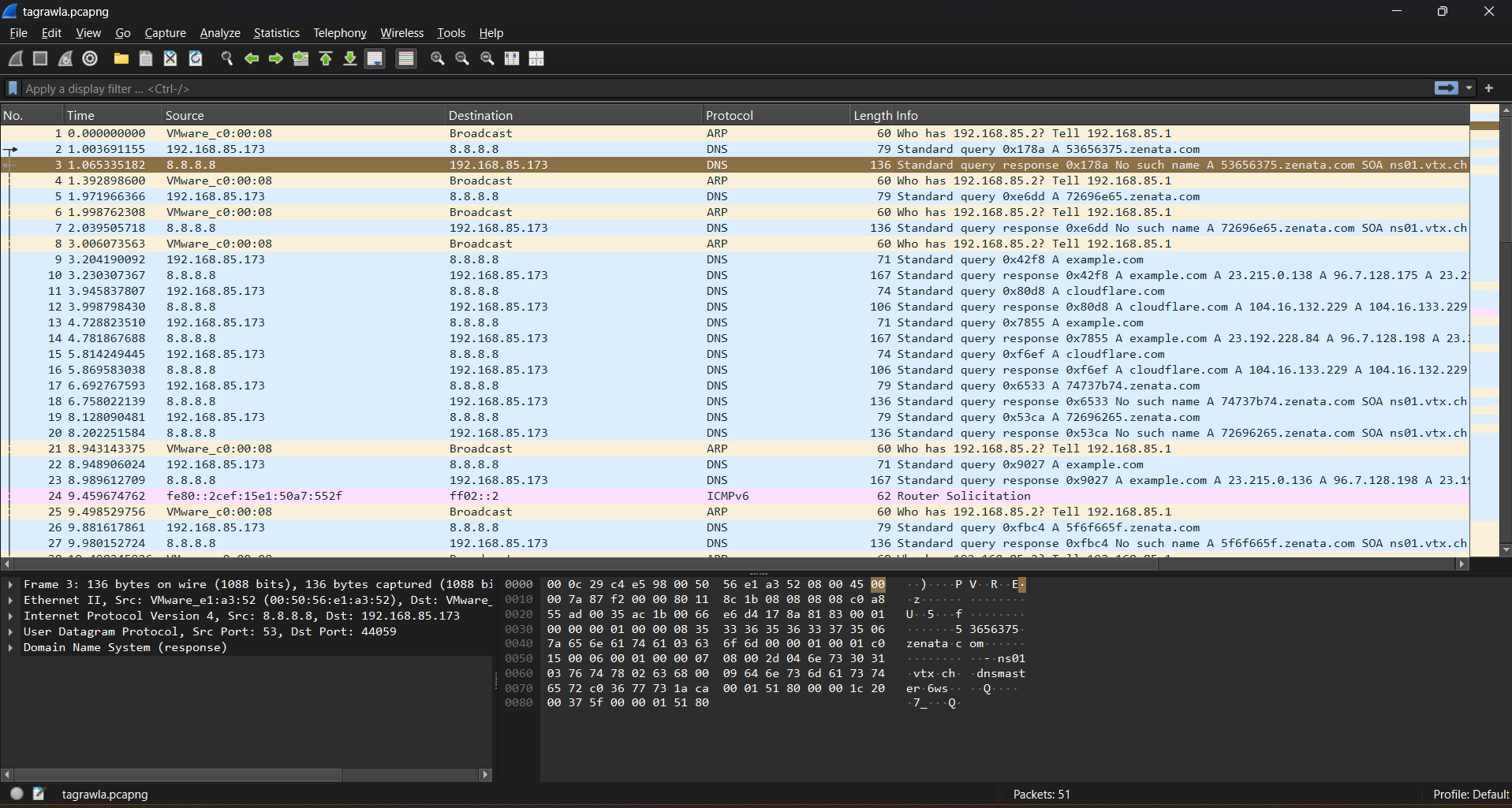
To filter DNS traffic, we can use the Wireshark display filter dns. This reveals a number of normal dns messages to google, cloudfare… and, to a domain name, zenata.com, that suspeciously, never returns a valid response. Upon inspection the first part of each request (e.g., 343536) varies between packets and is suspiciously hex-like in format.
Step 2: Spot the Pattern
It becomes clear that these subdomains consistently follow the format:
<hex_string>.zenata.comThis is a common exfiltration technique where the attacker encodes data into the subdomain labels of DNS queries. Since the domain name system is hierarchical and distributed, DNS traffic can often pass through unnoticed in many environments, making it a viable covert channel.
Step 3: Extract and Decode
We now want to extract the unique hexadecimal subdomain prefixes and reconstruct the exfiltrated payload. Sorting and deduplicating helps avoid noise from repeated packets.
To test whether it’s meaningful, we decode the first label as a hexadecimal string:
hex: 53656375 → ASCII: SecuThis is promising—it matches the beginning of the flag format Securinets{…}.
So, the idea is to:
- Extract all DNS queries to .zenata.com
- Collect the first label (before .zenata.com)
- Deduplicate them in the order seen
- Concatenate and decode as hex → ASCII
This can be scripted with pyshark as shown below.
Solution Script
import pyshark
import sys

def extract_unique_hex_labels(pcap_file):
    try:
        capture = pyshark.FileCapture(pcap_file, display_filter='dns')
    except Exception as e:
        print(f"[!] Could not open file: {e}")
        return ""

    seen = set()
    hex_fragments = []

    for packet in capture:
        try:
            if 'DNS' in packet and hasattr(packet.dns, 'qry_name'):
                qname = packet.dns.qry_name.lower()
                if qname.endswith('.zenata.com'):
                    first_label = qname.split('.')[0]
                    if first_label not in seen:
                        seen.add(first_label)
                        hex_fragments.append(first_label)
        except AttributeError:
            continue

    capture.close()
    return ''.join(hex_fragments)

def decode_hex_payload(hex_payload):
    try:
        return bytes.fromhex(hex_payload).decode('ascii')
    except Exception as e:
        return f"[!] Decode error: {e}"

if __name__ == "__main__":
    if len(sys.argv) != 2:
        print("Usage: python solver.py <file.pcapng>")
        sys.exit(1)

    file_path = sys.argv[1]
    print(f"[+] Processing: {file_path}")

    hex_data = extract_unique_hex_labels(file_path)
    print(f"[+] Extracted hex (unique): {hex_data}")

    decoded = decode_hex_payload(hex_data)
    print(f"[+] Decoded ASCII: {decoded}")
Running the script on the provided capture file yields:
python .\solver.py .\taskfiles\tagrawla.pcapng
[+] Processing: .\taskfiles\tagrawla.pcapng
[+] Extracted hex (unique): 5365637572696e6574737b74726962655f6f665f626c616465735f7368616c6c5f726973657d
[+] Decoded ASCII: Securinets{tribe_of_blades_shall_rise}